linkedin px ads

Top 10 Countries that Speak the Most Languages

|
Top 10 Countries that Speak the Most Languages

Font size:

Getting your Trinity Audio player ready...
Many countries around the world have one or two languages spoken by the majority of their people. There are however, a handful of countries worldwide that speak more than one language. These linguistically diverse nations have come about due to multiculturalism and globalisation, leading to some countries having a whopping 840 languages spoken in total (find out which ones later on).

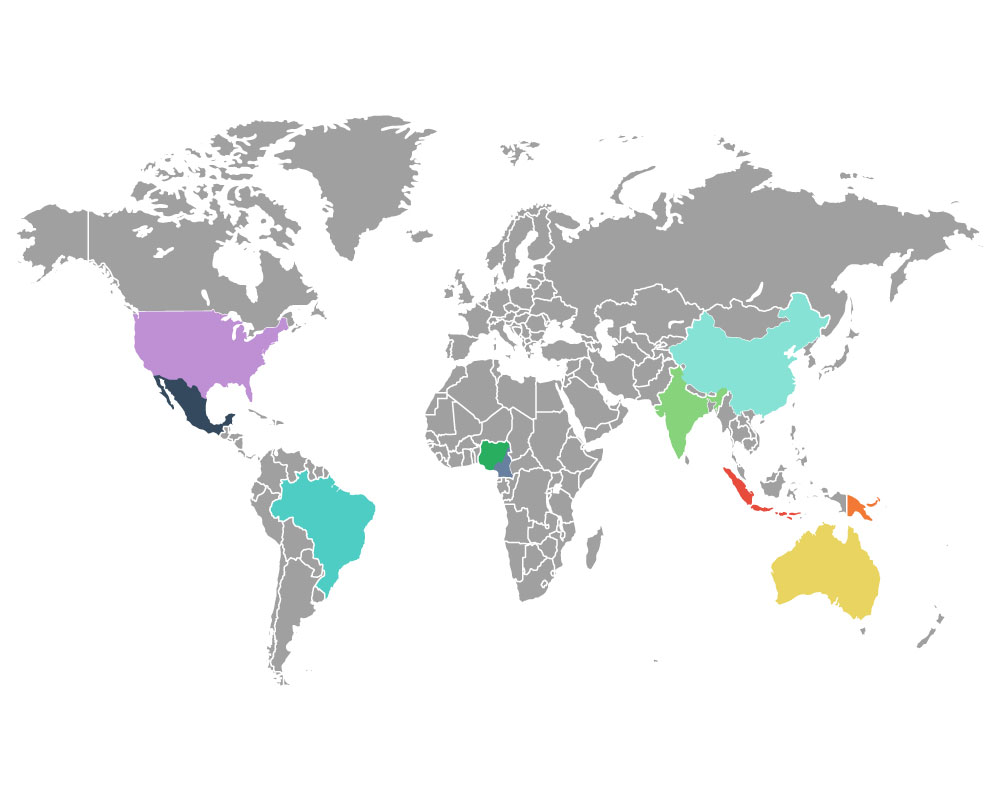
In this post, we uncover the top 10 countries that speak the most languages, along with their current internet penetration rates (language counts from Ethnologue; internet penetration from DataReportal, 2025):
Key Takeaways:
  • Papua New Guinea’s 840-plus languages average out to roughly one for every 12,000 people – a density no other country comes close to matching.
  • Indonesia (721 languages) and Nigeria (538) complete the top three – both shaped by terrain that kept communities separated for centuries.
  • Not every country here has made its dominant language official: Australia has no de jure official language at the federal level, while the United States only designated English as its official language in 2025.
  • India’s constitutional language list covers just 22 entries – barely 5% of the 450-plus living languages spoken across the country.
  • Language counts vary between sources depending on whether they include immigrant languages, creoles, and sign languages alongside established indigenous tongues.

10.Brazil

Brazil may have one of the world’s highest populations, but it does come last in the list of countries with the most languages spoken. Portuguese is the official and national language, however, aside from this, there are several other tongues used – a total of 228 in fact – around 217 of which are indigenous. The country’s minority languages include indigenous languages, such as Nheengatu, Italian, German and Japanese.

Top Language & Internet Penetration: Brazilian Portuguese (86.2%)

9. Australia

Australia has no official language. However, English is considered the de facto national language. Collectively, Australia has over 300 spoken languages in total, including more than 200 indigenous languages and over 90 brought by immigrant communities. Mandarin is the most common non-English language, followed by Punjabi, Filipino/Tagalog, and Arabic.

Top Language & Internet Penetration: English (97.1%)

8. Cameroon

Cameroon is home to around 275 living languages, according to Ethnologue. Some earlier estimates placed the number even higher, though many of those counts included dialects alongside distinct languages. French and English are official tongues, however other languages make up the country’s linguistic diversity including Bafia, Bafut and Bakoko.

Top Languages & Internet Penetration: French & English (41.9%)

7. Mexico

Although Spanish is the most widespread language of Mexico, the nation has around 292 languages in total. The Mexican government recognizes 68 national languages – 63 of which are indigenous.

Top Language & Internet Penetration: Spanish (83.3%)

6. China

China may have the highest population around the world, but it stands at 6th place in this list of countries with the most languages. Standard Chinese is the official language in mainland China, and another language that has official status is Cantonese. In total however, China has over 300 living languages, including regional varieties such as Wu, Min, and Hakka alongside the official standard, Mandarin.

Top Language & Internet Penetration: Mandarin (78.0%)

5. United States

You’d be surprised to know that the USA only designated English as its official language in 2025 – before that, it had none at the federal level. Even so, English is just one of hundreds of languages spoken across the country, including roughly 200 indigenous languages and dozens of established immigrant tongues. Spanish, Chinese (and its varieties), French, and Tagalog are among the most common.
Top Language & Internet Penetration: English (93.1%)

4. India

India’s constitution recognizes 22 languages under its Eighth Schedule, including Hindi, Bengali, Tamil, Telugu, Marathi, Urdu, and Gujarati. In total, India has over 450 living languages – making it the fourth most linguistically diverse country on earth.
Top Languages & Internet Penetration: Hindi and English (55.3%)

3. Nigeria

There is a countless number of African languages in the world. Nigeria houses 538 living languages overall, according to Ethnologue. The official one spoken is English but Igbo is another widely used language, spoken by over 30 million people.

Top Language & Internet Penetration: English (45.4%)

2. Indonesia

Indonesian (Bahasa Indonesia) is the national lingua franca, but the country is home to 721 distinct languages in total – the vast majority indigenous to its 17,000-plus islands.
Top Language & Internet Penetration: Indonesian (74.6%)

1. Papua New Guinea

And so, the country with the most spoken languages in the world is officially Papua New Guinea. Papua New Guinea has over 840 living languages – the highest count of any country on earth. This island nation in the southwestern Pacific has a population of roughly 10 million, yet its number of languages is more than double the total spoken across all of Europe.

Top Languages & Internet Penetration: Tok Pisin, Hiri Motu & English (24.1%)

Interested in translating your content into one of these languages? Get in touch!

FAQ

Which country has the most official languages?

Bolivia leads with 37 – Spanish plus 36 indigenous languages recognized under its 2009 constitution. Among the countries on this list, India recognizes the most – 22 languages constitutionally, though Hindi and English are the two used for central government business. Zimbabwe has 16 official languages, and South Africa has 12 (Zulu, Xhosa, and Afrikaans among them, plus South African Sign Language, added in 2023).

How many languages are spoken in the world?

Ethnologue currently documents over 7,000 living languages worldwide. Asia accounts for the largest share (around 2,300), followed by Africa (over 2,100). However, roughly 40% of these languages are considered endangered, with some having fewer than 1,000 remaining speakers.

Why does Papua New Guinea have so many languages?

Its geography is the short answer. The country’s highlands, coastal swamps, and thick jungle created natural barriers between groups for millennia. With over 600 islands and some of the most rugged landscape on earth, populations lived in near-total isolation – and each developed its own language as a result.

Does having more languages make a country harder to do business in?

It can add complexity, but it also creates opportunity. Businesses that invest in multilingual communication – through translation or localization – reach audiences that competitors overlook. In Nigeria, for example, marketing in Hausa, Yoruba, and Igbo alongside English can dramatically expand reach beyond the urban, English-speaking minority.


 
Share this article!
Pangea Localization Services

SEND US YOUR REQUEST