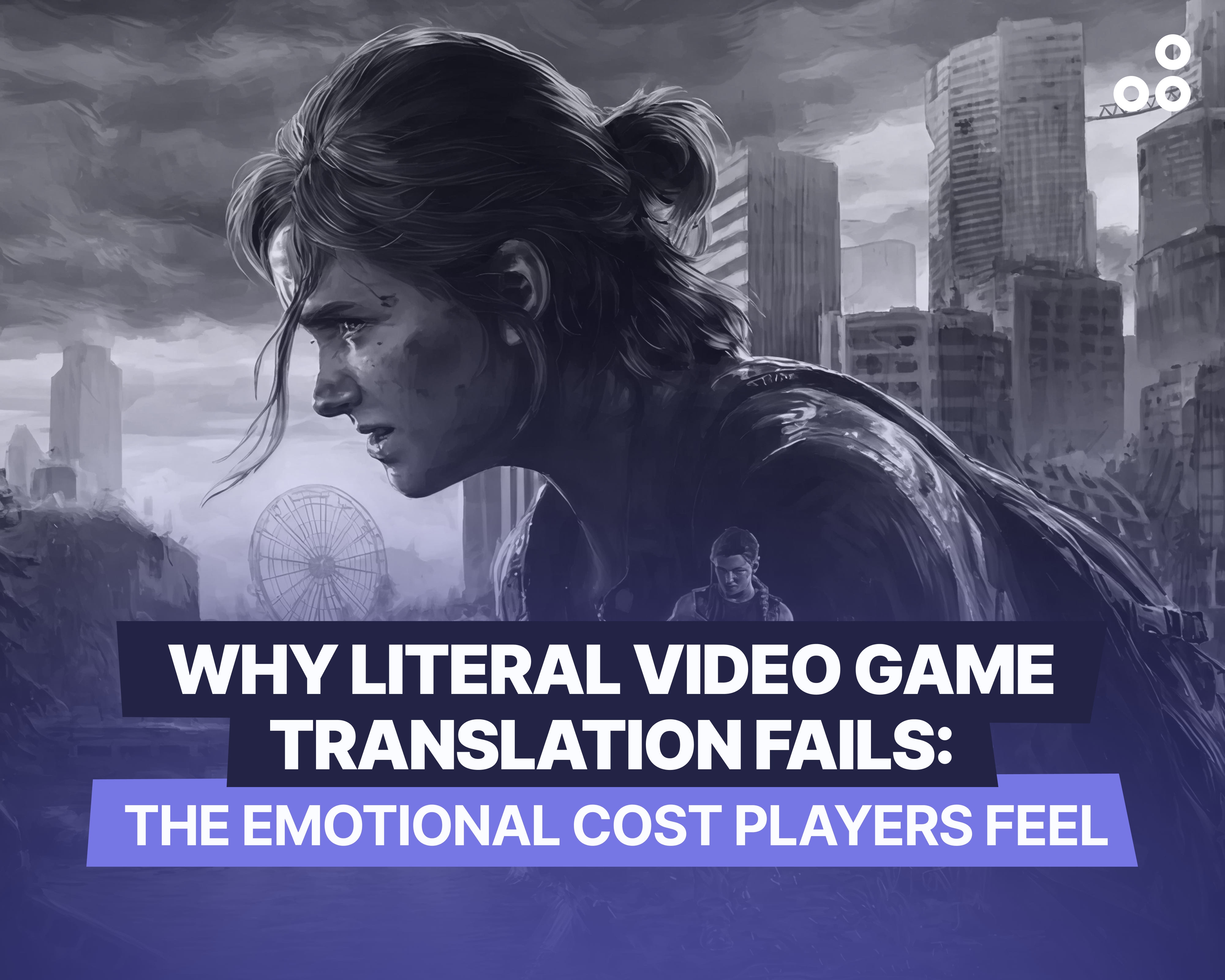
Why Literal Video Game Translation Fails: The Emotional Cost Players Fee
|
Font size:
A translated line can be grammatically perfect and still ruin a scene. Imagine a villain’s threat sounds polite or a farewell that should break your heart reads like a weather report. Players can’t always name the problem, but they feel it instantly, and their reviews reflect it.
This is the gap between accurate and effective video game translation. Whereas literal accuracy transfers words, emotional fidelity transfers the experience. Literal video game translation fails because it preserves meaning while stripping away tone, rhythm, and character voice – the elements players actually respond to.
This article looks at how literal translation undermines player immersion across every genre. It covers the specific tonal failures and their business impact, and also walks through the practical steps studios take to protect tone and character voice during the video game localization process.
Key Takeaways
- Literal translation preserves meaning but strips away tone, rhythm, and dramatic weight, leaving dialogue technically correct but flat on delivery.
- The five most common expressive failures are tone mismatch, dead humor, hollow dramatic peaks, rhythm clashes with voice acting, and register misalignment.
- Not every line needs creative treatment. UI strings and system messages work fine as literal translations, but dialogue and cutscenes don’t.
- Tonally flat translation generates “sounds translated” feedback in reviews, which is one of the hardest perceptions for a studio to reverse.
- Context documentation with emotional intent notes is one of the highest-ROI steps for protecting translation quality.
- Studios that pair gamer-translators with voice direction documents catch delivery failures before they reach players.
What Literal Video Game Translation Actually Looks Like
Literal video game translation is the practice of converting source text word by word, preserving grammar and definitions while ignoring tone, rhythm, and expressive nuance. That approach works fine in technical documentation, but in a game, it takes away what makes dialogue feel alive.
Consider a line from a defiant character facing defeat. The source says something like “I’m not done yet.” A literal translation might produce the equivalent of “I have not yet finished.” Same meaning. Completely different energy. The first is a fist-on-the-table moment; the second is a progress update.
This distinction matters because players don’t process dialogue as text; they process it as emotion. When the words are technically right, but the feeling isn’t, players can sense that something just doesn’t feel right. Steam reviews put it bluntly. Players write “sounds translated,” “awkward dialogue,” or “characters feel flat.” None of those reviews blame accuracy. They blame the result of prioritizing it above everything else.
The difference between translation and localization is not just academic. It defines whether your game reads like a converted document or a living world.
Core Idea: Literal translation gets the words right and the feeling wrong. Players judge dialogue by emotional impact, not dictionary accuracy.
Five Ways Flat Video Game Translation Kills Emotional Impact
Tonal failures in video game translation follow predictable patterns. The following video game localization examples show exactly where literal approaches break down, and where creative adaptation earns its budget.
1. Tone Mismatch: The Villain Who Sounds Polite
Tone lives in word choice, sentence length, and rhythm – not in meaning alone. A threatening character’s line might translate literally into something grammatically intimidating but tonally neutral. The menace disappears. A sarcastic sidekick’s quip becomes a flat observation.
Genshin Impact’s English localization drew sustained player criticism for exactly this problem. Characters like Zhongli (a patient, fatherly figure in the Chinese original), came across differently in English. Xiao, who speaks softly and indifferently in Chinese, sounded aggressive in the English dub. The words were fine, but the tone was off, and players noticed.
2. Humor That Arrives Dead
Comedy depends on timing, cultural reference, and wordplay – three things word-for-word translation handles poorly. A pun that works in Japanese collapses when translated word for word into English. A culturally specific joke becomes a sentence that makes grammatical sense but has zero comedic impact.
The history of humorous video game translations is full of lines that were funny in the source language and baffling in the target. The cost isn’t just a missed laugh; it’s a missed moment of connection between the player and the game.
3. Emotional Peaks That Fall Flat
The farewell scene. The sacrifice. The confession. These moments carry a game’s dramatic weight, and they’re where direct translation does the most damage.
Final Fantasy X’s iconic farewell offers a well-documented example. In the Japanese original, Yuna says “thank you” – a phrase that, in context, carries layers of farewell, comfort, and unspoken love. The English localization team adapted this to “I love you,” recognizing that a literal “thank you” would lose the emotional depth for Western audiences. Some fans debated the choice, but the localization team understood something critical: preserving the scene’s impact mattered more than preserving its exact words.
4. Dialogue Rhythm That Fights the Voice Acting
Translated text has to work with the voice performance, not against it. When sentence structure doesn’t match the pacing of the recorded audio, players hear a disconnect between what they see and what they read.
Final Fantasy XVI tackled this by recording English voice-over first – a reversal of the traditional Japanese-first process. The English script shaped facial capture and motion capture, so dialogue rhythm and delivery matched from the start. Reviewers and players widely praised the result as one of the franchise’s most natural-sounding localizations.
5. Register Mismatch: The Teenager Who Talks Like a Textbook
Every character has a speech register – the level of formality, slang, and vocabulary that defines how they sound. A street-smart rogue uses contractions and short sentences. A royal advisor favors longer, measured phrasing.
Word-for-word translation often flattens these distinctions. Characters who sounded distinct in the source language start blending together in the target. The result is a cast where everyone speaks at the same level, and none of them sounds like real people. This is one reason studios invest in building localization teams with translators who play the genres they translate.
Key Point: Each failure type (tone, humor, high-stakes scenes, vocal rhythm, register) demands its own adaptation strategy. Dictionary accuracy alone solves none of them.
Which Game Text Needs Literal Translation – and Which Doesn’t
Not every string in a game needs creative adaptation. Applying the same treatment to error messages and emotional cutscenes wastes budget and slows production. The practical question is: which text belongs where on the spectrum?
Literal translation works for: UI labels, system messages, menu text, error codes, technical documentation, and tutorial instructions. These require clarity and consistency – standard translation services handle them efficiently. Creative rewording here adds risk without adding value.
Adaptation works for: Most in-game dialogue, item descriptions with personality, loading screen tips, and marketing copy. The source meaning stays intact, but phrasing shifts to sound natural in the target language.
Transcreation works for: Humor, wordplay, idioms, emotionally charged scenes, and culturally anchored references. These lines can’t survive literal transfer. They need to be rewritten to achieve the same effect (even if the final words bear little resemblance to the source).
The studios that handle this well build a decision framework into their localization kits. They tag content by treatment level during pre-production, before translators ever see the strings. That way, linguists know which lines to translate closely and which ones need room to breathe. Defining this localization approach early saves time, budget, and creative energy.
Quick Recap: Match the translation approach to the content type. Literal accuracy for functional text, adaptation for standard dialogue, and transcreation for moments that carry emotional or comedic weight.
What Emotionally Flat Game Translation Costs Your Studio
The business case for tonal quality in game translation is not abstract. It shows up in specific, measurable outcomes.
Player reviews signal it first. Steam and console store reviews consistently flag “awkward translation” and “stiff dialogue” as negatives. This happens even when the underlying game is well-designed. For story-driven titles, translation quality directly shapes the review score. Hollow Knight: Silksong showed this in September 2025. The game earned 92% approval in English but dropped to 42% in Simplified Chinese, where players called the translation tonally mismatched and overly archaic. Same gameplay, same art, but a tonal mismatch in one language cut the approval rating by more than half.
Retention drops in narrative-heavy games. When players feel disconnected from characters and story, they drop off. Industry experience shows that session times shorten and completion rates drop. For live-service games, that means lower engagement with paid content updates – a direct revenue impact.
Brand perception sticks. “Poor localization” becomes part of how players talk about a studio. That label follows future releases. It makes players hesitant to buy at launch in other markets, waiting instead for community feedback on translation quality. Steam recognized this pattern. In August 2025, Valve introduced language-specific review scores, separating ratings by language so localization problems in one market no longer hide behind strong scores elsewhere.
Post-launch patches cost more than upfront investment. Fixing tonally flat dialogue after release means coordinating retranslation, re-recording voice lines, retesting, and redeploying. Studios that handle LQA testing properly during production catch these issues at a fraction of the post-launch cost.
Bottom Line: Flat translation rarely saves money. More often, it shifts costs to the post-launch phase, where everything is more expensive and harder to fix.
How Studios Protect Emotional Tone in the Video Game Localization Process
When localizing games with narrative weight, protecting expressive quality is not a single step. It’s a set of practices built into the localization pipeline from pre-production through final QA.
Context documentation with emotional intent. The most impactful change a studio can make is tagging strings with performance context. That means going beyond who speaks and where, and specifying how the line should feel. “This is a bitter farewell” or “this is dry sarcasm” gives translators the information they need to make the right creative choices.
Gamer-translators who play the genre. A translator who has spent 200 hours in RPGs understands how dialogue feels during a boss confrontation versus a campfire conversation. That instinct can’t be replaced by a glossary. It’s also why studios look for linguists who actively play games – the more they know the genre, the better they can capture the right tone in every line.
Voice direction documents for written text. Character voice isn’t just a voice-over concern. Tone cards describe each character’s vocabulary level, sentence style, and default tone. When translators receive these documents, they produce text that carries the right energy before a voice actor ever sees the script.
Emotional benchmarking in LQA. Standard linguistic QA catches spelling and grammar. This step goes further: testers play key scenes in the target language and evaluate whether the emotional response matches the source. Does the joke land? Does the threat feel threatening? Does the farewell hurt? This kind of testing requires cultural sensitivity and in-context play – not spreadsheet review.
The common thread across all of these practices is that they put quality first. Studios that invest in expressive accuracy during production avoid the costly cycle of player complaints, review damage, and after-release patches.
In Practice: Tonal quality comes from context, genre expertise, character documentation, and in-game testing. Each layer catches failures that the previous one missed.
When Game Localization Feels Like the Original
The best video game translation is invisible. Players in Berlin, São Paulo, and Tokyo should feel like the game was written for them – not converted from another language. That’s the standard.
Reaching it means treating localization as creative work, not text replacement. It means giving translators context, time, and permission to write – not just convert. And it means testing the result the way players will experience it: inside the game, in motion, with audio and visuals working together.
As Ted Woolsey demonstrated decades ago with his creative localizations of classic JRPGs, the lines players remember most are rarely the most literal. They’re the ones that landed emotionally.
If you’re preparing a multilingual release, protecting narrative impact across languages starts with the right partner. Explore our game localization services to see how we work with studios across 75+ languages. Or get in touch directly – we’ll review your project scope and target languages. No strings attached.
FAQ
Why does game localization cost more than literal translation?
Game localization costs more because it involves creative adaptation, not just word replacement. Adaptation typically adds 20–40% per word over literal translation, according to industry estimates. Full transcreation (needed for humor, wordplay, and high-stakes scenes) costs more still, as it requires creative rewriting. For dialogue-heavy games, the added investment is typically offset by reduced post-launch rework and stronger review scores.
Can AI preserve emotional nuance in game translation?
Current AI translation tools handle functional text well but struggle with tone, humor, and character voice. Many studios use machine translation for high-volume support content and human translators for player-facing dialogue and narrative.
Which game genres need the most emotional adaptation?
RPGs, visual novels, and narrative adventure games require the most creative treatment due to their reliance on dialogue and character relationships. However, any genre with voiced characters or story elements benefits from creative adaptation.
How do studios test whether translation preserves emotional tone?
Through narrative LQA. Unlike standard linguistic QA, which checks grammar and terminology, narrative LQA evaluates whether key scenes deliver the intended emotional response in each language. Testers play through critical story moments and flag lines where tone, humor, or dramatic weight falls short.
What’s the difference between adaptation and transcreation in games?
Adaptation adjusts phrasing to sound natural in the target language while keeping the source meaning. Transcreation rewrites content entirely to produce the same emotional or comedic effect, even if the final words differ significantly from the original.