How Indie Studios Localize on a Tight Budget
|
Font size:
Most indie studios delay localization for the same reason: they assume it costs more than they can afford. A quick search for game localization costs returns figures from $2,000 to $200,000. That range is not helpful when you’re working with a fixed game localization budget and an unfinished build.
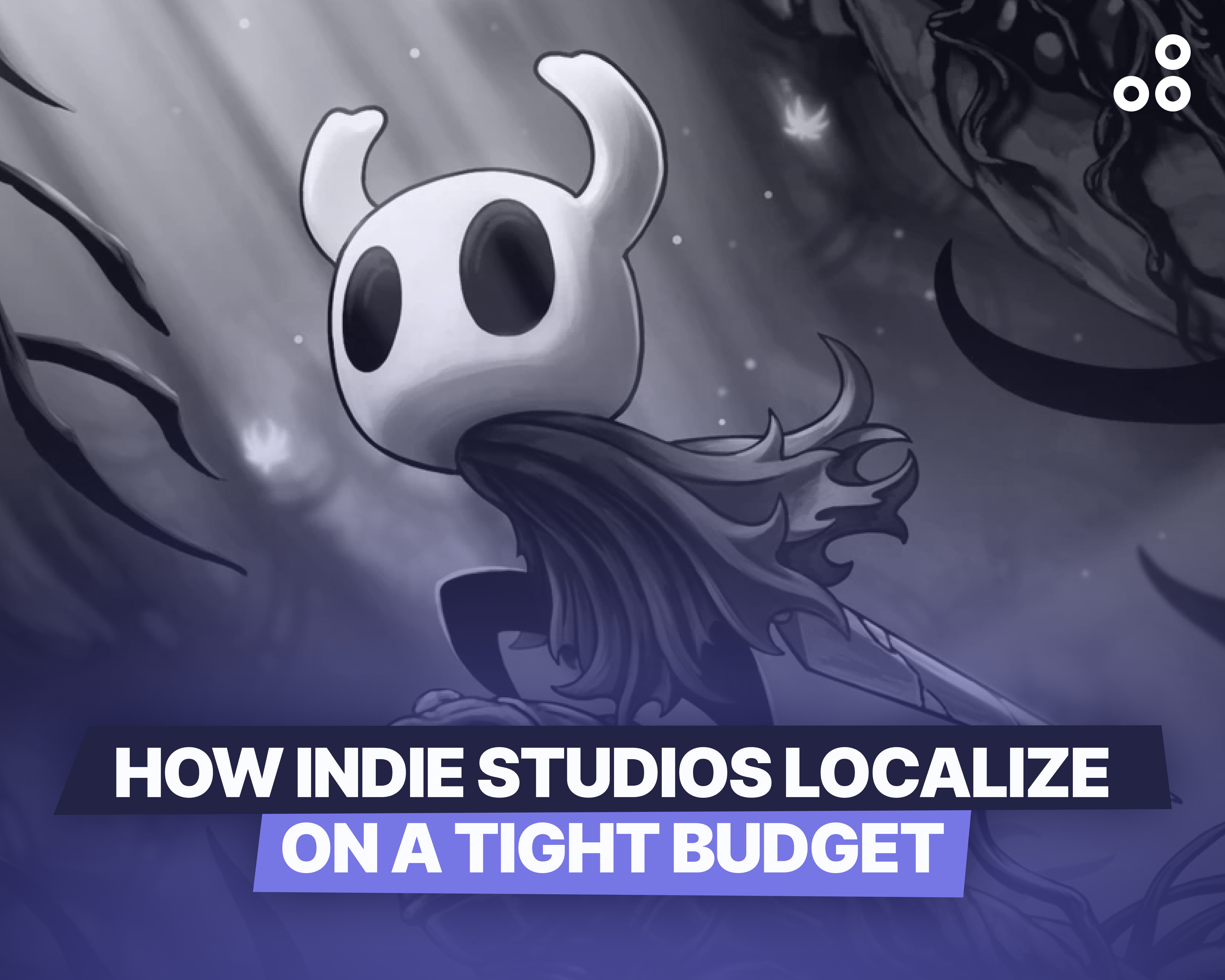
But the studios behind some of the biggest indie hits didn’t wait for AAA money. Vampire Survivors launched in English, added fan translations during Early Access, then replaced them with professional work for its 1.0 release. Hollow Knight shipped in February 2017 in English only. Within months, Team Cherry added five more languages, reaching six total by mid-2017. The studio launched its sequel Silksong on September 4, 2025. The game sold over 7 million copies in its first three months. These aren’t lucky breaks. They’re video game localization strategies.
This guide breaks down how indie studios approach video game localization on a tight budget – from code preparation and language selection to choosing what to handle yourself versus what calls for professional game localization services. You’ll also learn how to phase your rollout so localizing games scales with revenue – not ahead of it.
Key Takeaways
- Internationalization (i18n) – externalizing strings, supporting Unicode, building flexible UI – is the single biggest cost-saver in indie game localization, and it’s free.
- Starting with 2–3 high-ROI languages based on wishlist data outperforms spreading a limited budget across 8–10 languages at launch.
- A text-light indie game (roguelike, puzzle) typically costs $1,500–$5,000 for 3 languages. A dialogue-heavy title runs $15,000–$35,000+ for 3–5 languages.
- Store pages, narrative dialogue, and legal content need professional translation. UI strings and tooltips can start in-house with a glossary and get polished later.
- Phased localization – that is, launching with core languages and then expanding based on player data – is how most successful indie studios manage game localization costs without front-loading risk.
- Rushing translations without in-game QA creates more problems than skipping localization entirely. Balatro pulled all non-English languages from its Steam listing before 1.0 after discovering inconsistent quality.
- Industry research suggests localization is one of the few factors consistently linked to increased visibility on Steam. Adding even one or two languages can expand your reach to non-English audiences across the platform.
What Makes Indie Game Localization Different from AAA
When AAA studios plan localization, they commit to 12–15+ languages months before launch. Budgets are locked, pipelines are rigid, and everything ships simultaneously. Indie studios operate under different constraints – but that also means different advantages.
Smaller teams can test markets before committing. Tools like Early Access, free demos, and Steam wishlists give you real data on where your players are – before you spend anything on translation. You can launch with a handful of top-performing languages and add more once revenue justifies it. That’s not a compromise; it’s a strategy most AAA studios can’t replicate.
The cost picture looks different, too. Here are three common indie scenarios to calibrate your game localization costs:
- Text-light games (roguelikes, puzzlers, platformers with ~5,000–10,000 words of UI and menus): 3 languages, text-only – roughly $1,500–$5,000. Think Vampire Survivors or Balatro territory.
- Mid-range indie titles (moderate dialogue, tutorials, lore entries with ~20,000–40,000 words): 5 languages with store page localization and basic LQA – roughly $6,000–$15,000. Hollow Knight fits this bracket.
- Dialogue-heavy indie games (narrative RPGs, visual novels with 80,000–150,000+ words): 3–5 languages with transcreation for key scenes and LQA – $15,000–$35,000+. Branching-path or lore-dense outliers like Hades (300,000+ words) and Disco Elysium (1,000,000+ words) push well beyond this bracket in both scope and cost.
These are industry-range estimates for planning, not fixed quotes. Actual game localization costs depend on language pairs, content complexity, vendor structure, and whether you include audio. Industry per-word translation rates typically range from $0.10 to $0.20, depending on language pair and content type. Always request itemized quotes for your specific project.
The teams behind these games didn’t start with massive budgets, but with a clear sense of what to spend on first – and what could wait. For more on how video game localization teams are structured at different scales, see Key Roles in Game Localization Teams.
Core Idea: Indie localization isn’t a scaled-down version of AAA. It’s a different model – one where flexibility, market testing, and phased investment replace rigid pipelines and simultaneous worldwide launches.
Prepare Your Code Before You Spend on Translation
The biggest money-saver in game localization costs nothing. Internationalization (i18n) –that is, the technical work that makes your code translation-ready – is something you do once. Skip it, and every localization dollar you spend later gets less efficient.
In practice,i18n comes down to this: externalize all player-facing strings into resource files (JSON, XML, CSV) instead of hardcoding them. Support Unicode (UTF-8) from the start so CJK characters, Arabic right-to-left text, and accented European characters render correctly. And design UI containers to handle text expansion (languages like German and French routinely run 20–30% longer than English).
Studios that skip this step pay twice. First, for the engineering rework to extract hardcoded strings, and then for retranslation and retesting after those strings change location or format. Retrofitting i18n into a finished codebase can cost more than the translation itself.
Balatro offers a cautionary example. The solo developer behind the hit roguelike card game pulled all non-English languages from the Steam store page before the February 2024 launch. Community feedback through Discord had revealed inconsistent terminology and poor quality across multiple languages. The translations were eventually restored in phases (12 languages with 3 more in beta), but the launch window was English-only. The lesson was that rushing translations into a build without in-context QA creates problems that outlast the time you saved.
Both Unity and Unreal Engine have built-in localization frameworks. Unity’s Localization package handles string tables, locale switching, and asset variants. Unreal’s Localization Dashboard manages text gathering and translation import. Set this up before your first conversation with a translator. While you’re at it, prepare a basic localization kit – a glossary, style guide, and context screenshots – so your linguists have reference material from day one. For a full walkthrough of the technical pipeline, check The Game Localization Process & 22 Tips to Make It Easier.
Essential Step: i18n is the one investment that helps reduce every future game localization cost. Having code that’s ready for translation before the first string is sent out eliminates the most common source of budget overruns in indie projects.
How to Choose Your First Game Localization Languages
The instinct is to localize into EFIGS (English, French, Italian, German, Spanish) plus Simplified Chinese, Japanese, and Korean. That’s 8–9 languages. For an indie studio with a $5,000–$10,000 budget, that math doesn’t work because resources end up spread too thin, resulting in mediocre quality across the board.
A better approach is to let your data pick the languages. Steam wishlists broken down by region are the single most useful signal. If 15% of your wishlists come from China and 12% from Germany, those are your first two targets after English. The geography of demo downloads and the activity in the Discord community tell a similar story.
There’s a platform-level incentive too. Independent analytics research suggests Steam localization is one of the few factors consistently linked to increased visibility on the platform. For a small studio competing against thousands of releases, that discoverability boost can matter more than an extra marketing push.
Even text-light indie games see meaningful non-English engagement. Vampire Survivors (a game with minimal UI text) has roughly 60% English-speaking players on Steam. Simplified Chinese accounts for 8% and Korean for 7%. For a game earning millions, two extra languages can pay for themselves within weeks.
Genre-market fit matters too. Strategy and simulation games perform well in Germany, while RPGs have outsized demand in Japan and South Korea. Mobile game localization, on the other hand, sees high engagement in Brazil and Turkey. If you’re localizing a mobile game, the priority stack differs from PC: more languages, less text per language, and app store optimization becomes part of the scope.
Start with your first two or three languages that match your actual player base, and then add more when purchase data confirms demand. Ultimately, tracking localization ROI by language helps you decide when to expand. For a deeper dive into language selection, see The 8 Most Frequent Game Localization Languages & How to Choose.
Bottom Line: Two well-localized languages that match your player demographics will outperform eight underfunded ones. Wishlist analytics and regional download data beat generic language lists every time.
What Indie Studios Can Localize In-House vs. What Needs a Pro
Not every string in your game needs the same level of investment. The key to managing game localization costs on a tight budget is matching the right approach to each content type.
Always professional: Your Steam store page and platform descriptions. This is your conversion page: players decide to buy based on what they read here, so poorly translated store copy directly suppresses sales. Narrative dialogue that carries emotional weight, humor, or character voice also needs a professional translator or transcreator. The same care applies to legal content, age rating submissions, and regulatory text.
Can start in-house: UI labels, menu text, tooltips, and system messages are more formulaic. Build a solid glossary and style guide first, then draft initial translations yourself or with bilingual team members and have a professional polish them later. This “localize in layers” approach cuts costs without gutting quality.
Handle with caution: community translation. Fan translations can work as a bridge – especially for text-light games with an active Discord community. Vampire Survivors used community-contributed translations during Early Access. But for its full release in October 2022, developer Poncle replaced them with professional game translation across more than a dozen languages. The fan contributors were credited, but the final product was professionally translated. Bear in mind that if your game is narrative-heavy or your community is small, community translation carries more risk than savings.
Think of localization as layers, not a single event. Ship text-only first, add LQA once you can afford it, and consider voice-over only when market data justifies it. Each layer builds on the previous one, and each can wait until it proves its ROI. If your vendor maintains translation memory (TM), repeated strings and post-launch updates cost less over time – a real advantage for live-service indie titles.
Studios exploring professional game localization services for the first time often start with this layered model. For more on how game translation and localization differ in scope, or how indie studios have scaled globally through strategic adaptation, those guides go deeper.
The Big Picture: Professional translation for high-impact content, in-house drafts with professional polish for the rest, and honest evaluation of community contributions. That’s how tight budgets produce credible localization across multiple markets.
Phasing Game Localization Costs: Start Small, Scale with Revenue
The most common budget mistake in indie localization is treating it as a one-time event. Studios try to translate everything at once, lock their entire budget before launch, and end up with no resources left for post-launch fixes or expansion.
A phased approach works better. Most successful indie games follow some version of it.
Phase 1 – Pre-launch or Early Access: Localize your store page, core UI, and essential in-game text into your first two or three high-ROI languages. This is your minimum viable localization. It puts your game in front of non-English audiences, generates purchase data, and costs a fraction of a full multilingual rollout.
Phase 2 – Post-launch: Use actual purchase figures, review sentiment, and regional wishlists to decide which languages to add next. Measure game localization costs against revenue per language to focus your spend. For instance, if Brazilian Portuguese players are your third-largest buyer group but you haven’t localized for them yet, that’s a clear signal. This phase often adds 2–4 more languages and includes basic LQA.
Phase 3 – Growth or DLC: Expand into additional languages, deepen LQA coverage, and consider voice-over localization if your game warrants it. At this stage, you’re investing confirmed revenue, not speculating.
Team Cherry is the textbook example of the video game localization process done right. Hollow Knight launched in February 2017 in English only. By mid-2017, the team had added French, German, Spanish, Simplified Chinese, and Korean. Russian, Japanese, and Portuguese followed later that year. Each expansion was funded by the game’s growing sales, leading up to Silksong’s release on September 4, 2025. It sold over 7 million copies in its first three months, according to Team Cherry’s December 2025 update. Eight years of phased localization investment had built the audience and the infrastructure to support a global launch.
LQA is one of the most common items indie studios defer to a later phase. That’s understandable given the cost, but even a lightweight QA pass catches truncation, encoding errors, and out-of-context translations that can tank your store reviews. To understand what LQA involves at different levels, see What Is Game Localization Testing in Its 3 Most Basic Levels.
Quick Recap: Phased localization turns a large upfront expense into a series of smaller, data-informed investments. Each phase funds the next. The studios that get this right not only save money, but also make sharper decisions because every move is backed by real player behavior.
Your Localization Starter Checklist
Before you contact a translation vendor or post in a localization Discord, make sure you can check off these items since each one reduces your game localization costs and improves output quality.
- Code is internationalized: strings externalized, UTF-8 supported, UI handles text expansion. Test your build in German or Japanese, and if anything truncates or breaks, fix it before sending files out.
- Total translatable word count calculated across all content types: in-game text, store descriptions, achievement names, marketing copy, and patch notes. Most indie games land between 5,000 and 50,000 words total.
- Priority target languages identified using wishlist data, demo analytics, or genre-market research. Compare your regional numbers against genre benchmarks. A 10% wishlist share from a genre-strong region outweighs 15% from a market that rarely plays your type of game.
- Localization kit drafted: style guide with tone instructions, glossary of key terms, context notes, or screenshots for ambiguous strings. Even a one-page glossary covering 20–30 core terms prevents inconsistency when multiple translators work on your project.
- Store page translation scope defined and flagged as professional-only. Include capsule descriptions, tags, and update announcements – not just the main store text.
- Budget allocated for professional review of all high-impact, player-facing content. Request itemized quotes from at least two vendors so you can compare per-word rates, minimum charges, and whether LQA is included or billed separately.
If you’re early in this process, even completing the first three items puts you ahead of most indie studios entering the game localization market. The rest can be built out as you approach your target launch window.
To see how a professional pipeline fits around your specific game, explore Pangea’s game localization services or reach out to the team directly. A quick scope call can save weeks of trial and error – whether you’re localizing games for the first time or scaling an existing catalog.
FAQ
How much does it cost to localize a small indie game?
It depends on word count, language count, and content complexity. The benchmark scenarios earlier in this article give a starting range for game localization costs. Expect roughly $1,500 for a text-light title in 3 languages, up to $35,000+ for a narrative-heavy game with transcreation. For accurate numbers, request itemized quotes from game localization service providers based on your actual word count and target languages.
Should I localize during development or after launch?
Start preparing during development: internationalize your code, build your localization kit, and calculate word count. But hold off on sending text for translation until your script is reasonably stable. Translating content that’s still being rewritten leads to rework charges. Many indie studios localize their store page before launch and add in-game languages in phases after Early Access confirms which markets are buying.
Can I use machine translation for my indie game?
Raw machine translation (Google Translate, DeepL) without human review is risky. It can produce grammatically plausible output that’s contextually wrong – especially for game-specific terminology and humor. Machine translation with professional post-editing (MTPE) is a more defensible option if the budget is tight. It typically costs 40–60% less than full human game translation while maintaining acceptable quality for UI text. Narrative content should still go through a human translator.
How many languages should an indie game launch with?
There is no universal number. The right answer depends on your budget, genre, and where your audience is. Most successful indie launches start with 2–3 carefully chosen languages beyond English, then expand post-launch. For mobile game localization, the number may be slightly higher because word counts per language tend to be lower. Trying to cover 8–10 languages on a tight budget usually drives up game localization costs while lowering quality across all of them.
What’s the difference between game translation and localization?
Game translation converts text from one language to another. Localization adapts the entire player experience – that is, text, UI layout, cultural references, date and currency formats, and sometimes visual assets. Even a simple indie game with minimal text may need adjustments like UI resizing for German or right-to-left layout for Arabic.
How do I find the right localization vendor for my indie game?
Look for a provider that specializes in games – not general document translation. A gaming-focused vendor understands string length constraints, platform terminology, and how to handle humor or lore without flattening it. In your first email, include your word count, target languages, timeline, and a sample file so the vendor can quote accurately. Ask whether they offer in-context review, how they handle translation memory across updates, and whether LQA is included or priced separately. Red flags include pricing by page instead of word, no gaming portfolio, and no questions about your engine or file format. Industry events like GDC’s localization roundtables and dev-focused Discord servers are good places to find vetted providers. You can also start with a single-language pilot project to test quality and communication before committing to a full rollout. For a sense of what a gaming-specialized pipeline looks like, explore Pangea’s game localization services.