Culturalization in Game Localization: How to Build a Strategy That Pays Off
|
Font size:
A studio can run a full game localization pipeline – translation, LQA, voice-over – and still face a ban in China or a boycott in Japan. The reason is rarely linguistic. It’s cultural. Maybe it’s a map that shows Taiwan as independent, a skeleton asset that breaks Chinese content rules, or a shrine interaction that offends a national religion. No amount of proofreading catches these problems.
Culturalization is the discipline that covers this gap. It evaluates a game’s visual, narrative, and interactive content for cultural fit in each target market – beyond what standard translation and localization handle. For studios shipping globally, it’s not a creative luxury. It’s a budget line with measurable returns: faster rating board approvals, fewer post-launch patches, and stronger player trust in every region.
This article is not about why culturalization matters – that case is already clear. It’s a practical framework that includes what culturalization encompasses, how to budget for it, who should own it, and how to prove its effectiveness. The sections below walk through that strategy step by step: scope, diagnosis, model selection, budgeting, ROI measurement, and partner evaluation. For foundational context, see our complete guide to game localization.
Key Takeaways
- Culturalization closes risks that standard game localization doesn’t touch: visual symbols, regulatory restrictions, and cultural context that translators aren’t responsible for catching.
- Cultural review typically adds 5–15% on top of a standard localization budget. Post-launch damage control (rushed hotfixes, pulled assets, negative press) costs multiples of that.
- GaaS titles, single-release AAA games, and mobile F2P products each need a different culturalization model.
- Culturalization is not censorship. It gives creative teams informed choices about what to adapt, what to keep, and what trade-offs each decision carries.
- Effectiveness is measurable: regional retention rates, market-specific review scores, rating board approval timelines, and post-launch incident counts all track culturalization impact.
What Culturalization Covers That Game Localization Doesn’t
Standard localization adapts language: text, UI, audio, subtitles. Culturalization adapts content: the symbols, references, visuals, and design choices that carry different meaning in different markets. Whereas a translator’s job is linguistic accuracy, a culturalization reviewer’s job is cultural risk assessment.
In practical terms, a culturalization review covers five areas that sit outside a standard localization scope:
- Visual and symbol audits: environment art, signage, icons, flags, gesture animations, and color usage reviewed against each target market’s norms.
- Regulatory compliance mapping: identifying content that triggers legal restrictions or rating board flags in specific regions.
- Narrative cultural review: evaluating historical references, religious elements, political sensitivity, and humor for market appropriateness.
- Character and representation review: checking for stereotypes, gender norms, and racial connotations that may not be visible to the development team. This layer also touches inclusive localization considerations that affect player trust across demographics.
- Audio and gesture review: assessing voice tone, body language, and culturally loaded sound effects.
These five layers exist because a game can be perfectly translated and still culturally inappropriate. The localization team catches language errors, while the culturalization team catches content risks. Treating them as the same function is how studios end up with post-launch surprises. For a broader view of why this distinction matters, see our overview of cultural sensitivity in game localization.
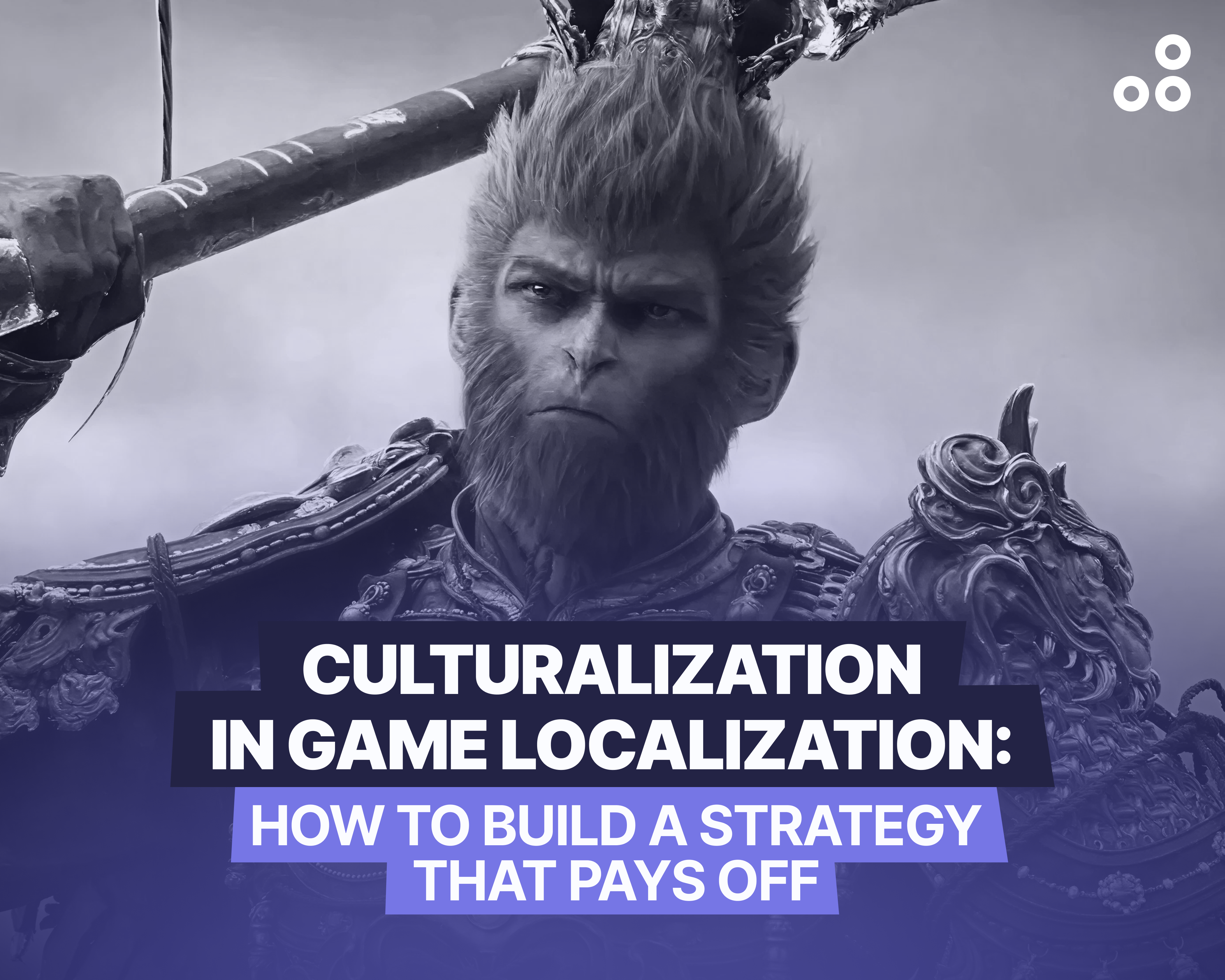
One common pushback from creative directors is that “culturalization means cutting our content”, when it actually doesn’t. Culturalization gives teams informed choices. Black Myth: Wukong is one of the most cited video game localization examples for a reason. The decision to keep Chinese terms like “yaoguai” and “loong” untranslated – selling 25 million copies – was exactly this kind of choice: preserve cultural identity, don’t default to Western equivalents. The opposite of censorship.
Core Idea: Culturalization and localization are complementary disciplines, not synonyms. Localization adapts language. Culturalization evaluates whether the game’s content, visuals, and design choices will land safely and effectively in each market.
Red Flags Your Game Localization Process Is Missing Culturalization
Most studios don’t skip culturalization on purpose. They assume it’s handled somewhere in their existing video game localization process. These signals suggest it isn’t.
Your translators are the only people reviewing content for cultural issues. That’s asking linguists to do a job they weren’t hired for. As stated before, translators catch language problems, whereas cultural reviewers catch content problems. These are different skill sets.
There’s no separate line item for cultural review in your localization budget. If culturalization has no budget, it has no owner. And if it has no owner, it happens ad hoc – or it doesn’t happen at all.
You discover regional restrictions during rating board submission, not during pre-production. By that point, fixing a flagged asset means emergency rework under certification pressure. It’s the localization equivalent of finding a game-breaking bug the night before launch.
Visual assets pass through linguistic QA only. A localization testing process that reviews only text misses environment art, signage, UI symbols, and gesture animations – all common sources of cultural flags.
You have no native-market reviewers for any target region. Without people who live inside the culture, you’re relying on assumptions about what’s acceptable. Those assumptions are how studios end up trending on social media for the wrong reasons.
Your culturalization “process” is an informal email from the PM asking: “Does this look okay for China?” That’s not a process. That’s a liability.
Quick Recap: If culturalization lives inside your translation workflow with no dedicated scope, budget, or specialists, it’s not happening. Occasional flags from team members don’t count as a process.
Culturalization by Business Model: AAA, GaaS, and Mobile F2P
Not every studio needs the same culturalization approach. The right model depends on your release cadence, content volume, and how many markets you’re targeting.
A single-release AAA title requires a front-loaded review. A full cultural audit happens in pre-production, covering visual assets, narrative themes, and regulatory requirements for all target markets. Milestone checkpoints at alpha and beta catch new content before it locks. Final compliance review runs before rating board submission. Budget is fixed and scoped upfront – no ongoing retainer.
GaaS / live-service models need continuous monitoring. Every patch, seasonal event, and battle pass introduces new content – and new cultural risk. A one-time audit at launch isn’t enough. Studios running live-service games need an ongoing review model. That means either an in-house cultural lead or a retainer with a localization partner who reviews each content drop before it goes live. This model prevents the kind of cascading edits that trip up games with rolling content updates.
Mobile F2P requires regional iteration at speed. Store screenshots, ad creatives, event banners, and push notification copy all carry cultural weight – and they cycle fast. Mobile culturalization operates on shorter timelines with a smaller scope per iteration but higher frequency. It also overlaps with ASO: keywords, descriptions, and visual assets in app stores need cultural adaptation, not just translation.
The common thread is that the culturalization scope should match your content lifecycle. A model designed for a single-ship AAA title will under-serve a GaaS game, and vice versa. When localizing games across multiple business models, the culturalization framework needs to flex accordingly. That flexibility extends to localization challenges in Asian markets, where regulatory requirements differ sharply between China, Japan, and South Korea.
Key Point: Match your culturalization model to your release cadence. Front-load for single releases, build continuous review for live-service, and optimize for speed and frequency in mobile F2P.
How to Budget for Culturalization – and Who Should Own It
Culturalization costs less than most studios expect – and far less than the problems it prevents. Industry practitioners commonly estimate that cultural review adds roughly 5–15% on top of a standard localization budget. The exact figure depends on market count, content volume, and regulatory sensitivity. In particular, games touching religion, politics, or historical conflict sit at the higher end.
Among the cost variables that move the needle, market count is the biggest driver. Reviewing content for 3 markets costs meaningfully less than reviewing for 15. Content type matters too. A text-heavy RPG with deep lore and historical references requires more review hours than a casual puzzle game with minimal narrative. And of course, regulatory complexity plays a role too. Markets like China, Germany, and the Middle East each carry specific compliance requirements that add review scope.
The prevention-versus-remediation math is straightforward. A cultural review during pre-production is a planned cost. A post-launch controversy (emergency patches, content takedowns, refund waves, negative press) is an unplanned one. Studios that have been through the second scenario rarely question the value of the first. Understanding game localization costs holistically means accounting for this cultural layer from the start.
Who should own it?
That depends on scale. Studios targeting 10+ markets with frequent content updates benefit from an in-house cultural lead. This person knows the IP deeply and coordinates with the dev team daily. The downside is that one person can’t cover every culture, so they still need external specialists for specific regions. For more on how these roles fit together, see our breakdown of game localization team structure.
For most studios, outsourcing is more practical. Among video game localization companies, the ones worth considering maintain networks of native-market cultural reviewers. An experienced game localization services provider can scale this coverage across regions without the overhead of full-time hires. Across CJK, MENA, and European markets, the cultural flags that surface most consistently involve visual symbols, religious imagery, and regulatory gaps. These sit outside a translator’s scope entirely.
The hybrid model – an internal cultural owner plus external specialist network – works best for mid-to-large studios. The internal lead sets standards, maintains the cultural risk log, and coordinates with the localization team. External reviewers provide the regional depth that no single person can cover alone.
Bottom Line: Culturalization is a fraction of the localization budget but covers risks that no other pipeline stage catches. The ownership model – in-house, outsourced, or hybrid – should match your market count and content cadence.
Measuring Culturalization ROI Beyond “No Scandal”
“We didn’t get banned anywhere” is a low bar. Effective culturalization delivers positive business outcomes – and they’re trackable.
Regional review scores are now visible at the platform level. Since August 2025, Steam has displayed language-specific ratings, separating player feedback by region. Hollow Knight: Silksong showed this clearly at launch in September 2025. English reviews sat at 92% positive. Simplified Chinese dropped below 45% – driven by a translation that players described as archaic and tonally mismatched. Team Cherry patched the translation within weeks, and the Chinese score has since recovered. But the launch-window gap demonstrated exactly what these scores are designed to surface.
Market-specific player retention tells a sharper story than global averages. If your Day-30 retention in Japan is 15 points below your global baseline, that’s a signal worth investigating. Cultural mismatch – beyond linguistic quality alone – is often the underlying factor.
Rating board approval timelines reflect preparation quality. A clean submission with pre-reviewed content moves through PEGI, ESRB, USK, or CERO faster than one that triggers back-and-forth over flagged elements. Studios that run culturalization review before submission consistently report shorter approval cycles.
Community sentiment per market is increasingly measurable. Social listening across Discord, Reddit, Steam forums, and regional platforms like Bilibili or Naver surfaces cultural friction early. A structured process for evaluating this feedback – and deciding whether it warrants a patch – prevents small issues from becoming reputation events.
Post-launch cultural incident count is the simplest metric. The target is zero. Every incident – a removed asset, an urgent hotfix, a public apology – strengthens the business case for culturalization on the next project.
None of these KPIs requires a new analytics platform. They layer onto existing reporting from your analytics stack, community management tools, and localization project tracking. The key is assigning someone to watch them.
To build the internal business case, frame it as two scenarios. Scenario A: The cost of cultural review across your target markets. Scenario B: The cost of one post-launch incident – an emergency patch across platforms, content re-review, rating board resubmission, and the community management hours that follow. For most studios, a single avoided incident covers multiple years of cultural review investment.
The Big Picture: Culturalization ROI shows up in regional retention, review scores, approval speed, and incident prevention. Track these metrics per market, and the investment case builds itself over successive releases.
What to Ask Your Game Localization Partner About Culturalization
If you’re evaluating a localization provider – or auditing the one you already use – these questions matter. They separate partners who treat culturalization as a real discipline from those who treat it as a checkbox.
- Do you staff in-market cultural specialists separately from translators? This is the baseline. If the same person translating your UI strings is also responsible for flagging a politically sensitive map asset, the process isn’t scoped correctly. Cultural review requires cultural insiders – not linguists doubling up.
- Can you show me a sample cultural risk report for a title similar to mine? A provider with real culturalization experience can show you what a deliverable looks like: flagged assets, severity ratings, recommended adaptations, and regional justifications. If they can’t produce a sample, the capability likely doesn’t exist as a formal workflow.
- How do you handle content that’s flagged but the studio wants to keep? This question reveals process maturity. The right answer is a documented risk assessment: what happens in market X if you ship this, and what’s the community risk. A provider who says “we’ll just remove it” misses the point. Culturalization is about deliberate trade-offs, not blanket cuts.
- What’s your review cadence for live-service content? If your game ships seasonal events, battle passes, or regular content drops, a one-time pre-launch audit isn’t enough. Ask how they handle ongoing coverage. Is there a retainer model? What’s the turnaround on a cultural check for a new content drop? Studios running GaaS titles need a partner who can match their release tempo.
- Which markets have you reviewed content for in the past 12 months? Culturalization knowledge is regional and perishable. Regulations shift, community expectations evolve, and platform policies change. A provider who reviewed Chinese content three years ago may not know about current enforcement patterns. Recent, active coverage in your target markets matters more than a long client list.
- How do you coordinate with the dev team when a cultural flag requires an asset change? This tests integration depth. The best video game localization process includes a clear escalation path: who gets notified, how fast, and at what stage. If the answer is “we send a spreadsheet at the end,” the feedback loop is too slow to prevent launch delays.
Any provider confident in their culturalization practice will welcome these questions. Hesitation or vague answers tell you everything you need to know.
Building Culturalization Into Your Pipeline: Where to Start
Culturalization is not an extra layer of bureaucracy bolted onto localization. It’s a risk management function with a measurable business outcome. Studios that build it into their pipeline launch faster, face fewer post-release emergencies, and earn stronger reputations in every market they enter.
The framework is straightforward. Define the scope – what your standard localization doesn’t cover. Diagnose your current gaps. Match the culturalization model to your business type. Budget it as a planned cost, not an afterthought. Assign ownership. Measure results. Even indie studios going global through localization benefit from a lightweight cultural review before launch.
The studios getting this right aren’t spending dramatically more. They’re spending smarter. When it comes to localizing games for global audiences, they ship with confidence that their content will land the way they intended.
If you’re preparing a multilingual release, explore our game localization services to see how we work across 75+ languages. Or get in touch directly – we’ll review your project scope, target markets, and flag potential cultural risks before they reach your players.
FAQ
How much does culturalization add to game localization costs?
Budget impact depends on three factors: the number of target markets, the depth of narrative content, and how many regions carry strict regulatory requirements. For a 10-language RPG with historical themes, cultural review can represent a meaningful addition to the localization line item. For a casual mobile title shipping to five markets, the cost is considerably lower. In either case, the spend is a fraction of what a single post-launch content removal or emergency rework cycle costs.
Can AI handle culturalization in video game localization?
AI tools can support parts of the process like flagging known regulatory terms, checking symbol databases, or scanning for previously documented sensitivities. But culturalization requires contextual judgment about how specific audiences will perceive specific content. That judgment depends on lived cultural knowledge. AI can accelerate the review, but it can’t replace the reviewer.
What’s the difference between localization and culturalization?
If the issue is a wrong word, a missing translation, or a broken UI string – that’s localization. If it’s an offensive gesture, a map violating territorial laws, or a religious symbol triggering a certification flag – that’s culturalization. The simplest test: could a linguist who doesn’t live in the target culture catch this problem? If not, it belongs in the culturalization scope, not the translation workflow.
Which game genres need culturalization the most?
Any genre that touches real-world themes carries a higher cultural risk. RPGs and strategy games with historical settings need it most. So do open-world games with detailed environments, and any title featuring religious imagery, political references, or region-specific humor. But even casual and mobile games face cultural flags like color symbolism, gesture meanings, and inclusive design considerations that apply across genres.
When should culturalization start in the video game localization process?
During pre-production. A content audit at the design stage identifies cultural risks before assets are created. This is when changes are cheapest and least disruptive. Studios that wait until certification to address cultural flags face rushed fixes, delayed launches, and higher costs. The earlier culturalization enters the pipeline, the more options the creative team has.