Cultural Pitfalls in Game Localization: Real Examples and Lessons Learned
|
Font size:
A cultural misstep in game localization can cost a studio more than the entire localization budget. When Epic Games adapted Fortnite for the Chinese market, the team had to remove or redesign skull-themed character skins to comply with local content regulations. That kind of adaptation, involving adjusting visuals, symbols, references, and narrative to fit a market’s cultural norms, is what the industry calls culturization. It goes a step beyond translation and even standard localization. And when studios skip it, the consequences range from day-one patches to government-level backlash.
This article breaks down real video game localization examples from 2024–2025, including one of the biggest controversies in recent Ubisoft history. Each case offers practical lessons studios can apply before launch. Whether you’re an indie developer localizing games for the first time or a publisher managing a multilingual portfolio, these examples show what cultural missteps look like and how to get it right.
Key Takeaways
- Culturization addresses cultural symbols, values, and sensitivities – all problems that standard translation and LQA cannot catch.
- Assassin’s Creed Shadows required a day-one patch and drew criticism from Japan’s Prime Minister after in-game content allowed destruction of a real Shinto shrine.
- Stellar Blade’s Korean developer shipped an unintentional racial slur visible in the English-language build, a blind spot that a single native-speaker cultural reviewer would have flagged.
- Black Myth: Wukong kept Chinese terms like “yaoguai” and “loong” untranslated and sold 25 million copies, proving cultural authenticity can be a commercial advantage.
- A one-word sensitivity edit in Honkai: Star Rail broke a plot point in a later patch, showing why localization teams need access to the full narrative context.
- Cultural review should be a defined pipeline stage with native-market specialists, not an afterthought handled by translators alone.
Why Cultural Pitfalls Keep Happening in Game Localization
Most studios plan for translation. They budget for gaming translation services, build glossaries, hire linguists, and schedule LQA rounds. But culturization, the review of visual, symbolic, and narrative content for cultural fit, rarely gets its own line in the production plan. It’s treated as something translators will “catch along the way.” And they usually don’t. A linguist’s job is language accuracy, not evaluating whether a shrine asset is sacred or a piece of graffiti carries a racial connotation in a market 8,000 miles away.
The result is a recurring gap across the industry: studios with hundred-million-dollar budgets keep making cultural mistakes that a single native-market reviewer would have flagged in pre-production. The four cases below, spanning AAA blockbusters, a Korean PS5 exclusive, a Chinese cultural phenomenon, and a global mobile game, all trace back to this same structural blind spot. Different games, different markets, same root cause.
Assassin’s Creed Shadows – When Cultural Research Falls Short
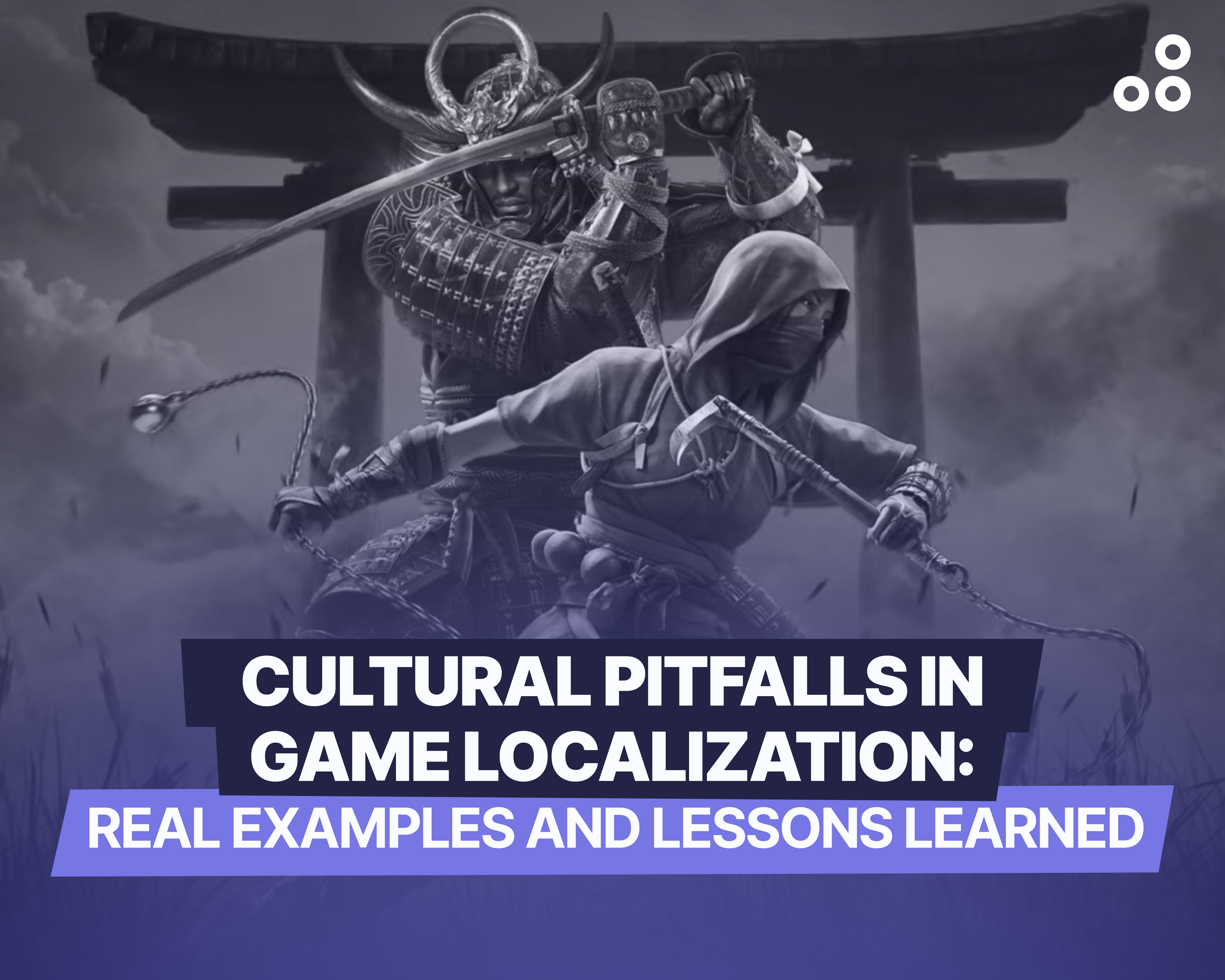
Assassin’s Creed Shadows became one of the most debated video game localization cases of 2025. In March, Ubisoft released the title set in feudal Japan. Within hours, the studio issued a day-one patch removing the ability to destroy objects inside Shinto shrines – a direct response to months of escalating controversy.
The problems started well before launch. In July 2024, a Japanese historical reenactment group discovered that Ubisoft had used its flag in promotional artwork without permission. Ubisoft Japan apologized publicly, but the group noted the art had already been printed in the collector’s edition artbook. Then Itatehyozu Shrine in Himeji, Hyōgo Prefecture, announced it would take action after seeing its real-world structure reproduced in-game, with destructible sacred objects inside. The shrine’s chief priest called it a serious offense to Shinto traditions.
The backlash reached the highest level of Japanese politics. Prime Minister Shigeru Ishiba called the in-game shrine destruction “an insult to the nation itself” and announced government discussions with relevant ministries. Ubisoft delayed the release twice, cancelled the season pass, and cut the collector’s edition price by $50.
The business impact was measurable. While the game reached 5 million players by summer 2025, Ubisoft cancelled plans for a second DLC expansion. The game localization costs of the original release pale in comparison to the price of post-launch damage control. Months of negative press in Japan’s largest media outlets, cancelled content, and reputational harm that’s harder to quantify and even harder to undo.
The core issue wasn’t a translation error. It was a failure of cultural research during development. No amount of linguistic quality assurance catches a design decision that allows players to smash a real shrine’s altar. That’s a culturization gap in the game localization pipeline, and the kind that requires cultural sensitivity expertise embedded early in production.
Core idea: Culturization failures don’t stem from bad translations. They stem from design and content decisions made without input from people who understand the target culture at a deep level.
Stellar Blade – a Cultural Blind Spot in Plain Sight
Stellar Blade launched on PlayStation 5 in April 2024. The game translation from Korean to English passed standard linguistic review without issue. But before release, reviewers spotted a different kind of problem: a graffiti tag reading “Hard” on a wall sat directly next to a neon sign reading “R Shop.” Together, they spelled out “Hard R” – a well-known euphemism for a racial slur in American English.
Sony, as publisher, confirmed the juxtaposition was accidental, noting that Korean developer SHIFT UP had no intention of creating offensive content. The “Hard” graffiti appeared in multiple locations as generic urban decoration. Sony issued a day-one patch changing the text to “Crime.” This is a pattern that video game localization companies see regularly: visual content created by artists who aren’t reviewing assets through the lens of every target market.
The fix was fast, but the lesson is clear. A single cultural reviewer familiar with the U.S. market would have flagged this during QA. SHIFT UP’s Korean team had no reason to recognize the reference since it was invisible outside American English. This is exactly the kind of blind spot that professional game localization services with native-speaker cultural testers are built to prevent.
Black Myth: Wukong – an Example of Video Game Localization That Paid Off
Not every cultural localization story is a cautionary tale. Black Myth: Wukong, released in August 2024 by Chinese studio Game Science, took the opposite approach, and it worked spectacularly.
Instead of translating Chinese mythological terms into English equivalents, the team preserved the original Pinyin. They used “yaoguai” instead of “monster,” “loong” instead of “dragon,” and “jingubang” for Sun Wukong’s staff. This was a conscious “foreignization” strategy, a game localization approach that keeps the source culture front and center rather than domesticating it for Western audiences.
Some Western players found the terminology unfamiliar. But the approach positioned the game as culturally distinct rather than generically globalized. The numbers speak for themselves: 10 million copies sold in three days. Within five months the total had reached 25 million, making it the largest global launch by a Chinese developer in history. For any studio weighing the risks of video game localization that preserves cultural specificity, those figures are hard to argue with.
The takeaway for studios considering video game localization: cultural authenticity isn’t always a barrier to sales. When paired with strong gameplay and a clear creative vision, it becomes a differentiator. This is one of the strongest examples of video game localization turning cultural identity into a commercial asset.
The big picture: Cultural adaptation doesn’t always mean smoothing out differences. Sometimes the smartest localization decision is to keep what makes your game unique and let players meet it on its own terms.
Honkai: Star Rail – how one word change broke the story
Honkai: Star Rail is a mobile game with a massive global player base and is a high-profile example of mobile game localization at scale. In patch 2.0 (early 2024), the English localization team replaced the word “mute” with “rock” in a character’s dialogue. The change was likely motivated by sensitivity concerns, since “mute” could be perceived as offensive to people with speech disabilities.
The problem surfaced one patch later. In version 2.1, the original word “mute” turned out to carry important narrative meaning tied to another character’s backstory. The substitution broke a plot connection that players noticed immediately. HoYoverse acknowledged the error and reverted the line.
Players also questioned the underlying workflow, speculating that localization teams worked patch by patch without access to future story arcs. That meant the translator making the sensitivity call had no way to know the word would matter later.
This is a textbook case of cultural sensitivity applied without narrative coordination. The intention was good, but the execution created a bigger problem than the one it tried to solve. It’s also a reminder that game localization for story-driven titles requires linguists who understand the full scope of the localization process, not just the current batch of strings.
How to Avoid Cultural Pitfalls in the Video Game Localization Process
The cases above share a common thread: cultural issues caught too late or not at all. Here’s what studios can do differently.
- Build culturization into the pipeline as a defined stage. Don’t rely on translators to catch cultural issues, as that’s not their primary role. Assign cultural review to native-market specialists who evaluate visuals, symbols, references, and narrative choices alongside the text.
- Start cultural review early in development, not during localization. The Assassin’s Creed Shadows controversy wasn’t a localization failure, it was a design decision. By the time translators see the build, it’s too late to fix structural cultural problems.
- Give localization teams full narrative context. Honkai: Star Rail’s issue happened because translators worked without knowing future plot developments. For story-heavy games, provide full scripts or, at minimum, flag story-critical terms.
- Include visual and UI review in your LQA scope. Stellar Blade’s “Hard R” wasn’t in the dialogue files. It was a visual element. Standard linguistic QA wouldn’t catch it. Cultural review needs to cover environment art, signage, symbols, and UI layouts.
- Treat cultural authenticity as a strategic choice, not a problem. Black Myth: Wukong proved that preserving source-culture terminology can strengthen a game’s identity globally. The decision to domesticate or foreignize should be deliberate, not reactive.
Bottom Line: Cultural pitfalls are preventable. The studios that avoid them treat cultural review as a production stage with dedicated specialists and early integration into the game localization timeline.
Final Thoughts
Every example in this article points to the same conclusion. Whether it’s a prime minister calling shrine destruction an insult to the nation or a one-word edit that broke a storyline, cultural adaptation is not optional. It’s a risk management function that belongs in the video game localization process from day one.
The good news: most cultural pitfalls follow predictable patterns. Religious and historical symbols, racial references invisible to non-native speakers, regulatory requirements around depictions of violence, and sensitivity edits made without narrative context. A structured cultural review catches these before they reach the player. And the game localization costs of prevention are a fraction of what post-launch damage control requires.
If you’re evaluating professional game localization services, we’re happy to discuss your project scope. Let’s talk about your game – we’ll review your scope and flag potential cultural risks before they become post-launch problems.
FAQ
What is culturization in game localization?
Culturization is the process of adapting a game’s visual, narrative, and symbolic content to align with the cultural norms and sensitivities of each target market. It goes beyond linguistic translation to address elements like religious symbols, historical references, color meanings, humor, and regulatory requirements.
What are common cultural mistakes in video game localization?
The most frequent issues include using real-world religious or historical sites without proper research, visual elements that carry unintended meaning in the target culture, and sensitivity edits that break narrative consistency. Studios also commonly apply domestic cultural assumptions to international markets. These tend to surface after launch when native-speaking players flag them publicly.
How much does it cost to fix a game localization mistake after launch?
Direct costs include emergency patches, re-recording voice-over, and re-testing across platforms. Indirect costs are often larger: negative store reviews, social media backlash, and damaged brand reputation. In extreme cases, government scrutiny adds regulatory risks. Studios that invest in cultural review during production spend a fraction of what post-launch fixes cost.
What is the difference between localization and culturization?
Localization adapts a game’s language, UI, and technical elements for a target market, translating text, adjusting date formats, and fitting strings into UI. Culturization goes deeper, evaluating whether the game’s content, visuals, and design choices are appropriate for each audience. A localized game can still contain cultural missteps if no one reviewed the non-linguistic elements.
Can you share more video game localization examples of culturization done right?
Beyond Black Myth: Wukong, studios like CD Projekt RED (The Witcher 3) invested heavily in cultural adaptation for each market, tailoring humor and references by region. The key pattern: studios that treat culturization as a production stage, with dedicated reviewers and early integration, consistently avoid the kind of post-launch damage described above. For a broader view, see our guide on what game localization involves.